My Central Bank Pyramid
This piece was originally distributed via my newsletter.
Central bankers play a pivotal role. The best are politically independent and work through institutions (instead of corroding them). They are like the maestros of an orchestra, sensing when the next instrument should play, or when more or less sound needs to come from the horns. The best central bankers make the monetary system and the overall economy better.
The current central bankers at the Fed and the Bank of Japan have big decisions coming up. I predicted in this piece earlier in the week that they’ll both hike a quarter point on Dec. 9th and Dec. 18th, respectively. But to understand the modern central banker, what incentivizes them, and what separates those who changed the system from those who just held the job, we need to explore some financial history.
We need to start in the central bank basement. Sometimes by studying what not to do or studying the worst of the worst, we can avoid repeating the same problems again. Even if history doesn’t exactly repeat itself, it often rhymes, and that’s certainly true in financial markets.
Let’s set some ground rules first
Every name I included in the Central Bank Pyramid had to pass a simple test — did they change how the machine works?
Simply running a central bank well isn’t enough. The greatest leaders in history didn’t just keep the lights on, they changed something for the better. They forced a fundamental shift in the system. Plenty of central bankers have held the job, held inflation at bay, and left the system exactly as they found it. Those folks may be good central bankers, but they’re not on this pyramid.
Every name in the pyramid gets scored in four areas:
- Scope: did they improve one market or the whole system?
- Durability: did the system they changed outlast them and survive a successor?
- Relevance: is that system still working today?
- Origination: did they invent the system themselves or did they execute someone else’s idea well?
For those of you who have read or watched some of my Jensen Huang content, you know I also value character. We need to make character — and consequences for a lack thereof — a thing again. So this Central Bank Pyramid is a hall of fame with a character clause. Fame has to be earned through the institution, not at its expense. If a central banker corroded the institution they were trusted to protect, they head straight to the basement.
For anyone still in office like Fed Chair Kevin Warsh or even Jerome Powell (who’s still on the Fed board!), they’re waiting on deck. It’s impossible to accurately judge durability while a person is still in the chair.
The Central Bank Pyramid shape
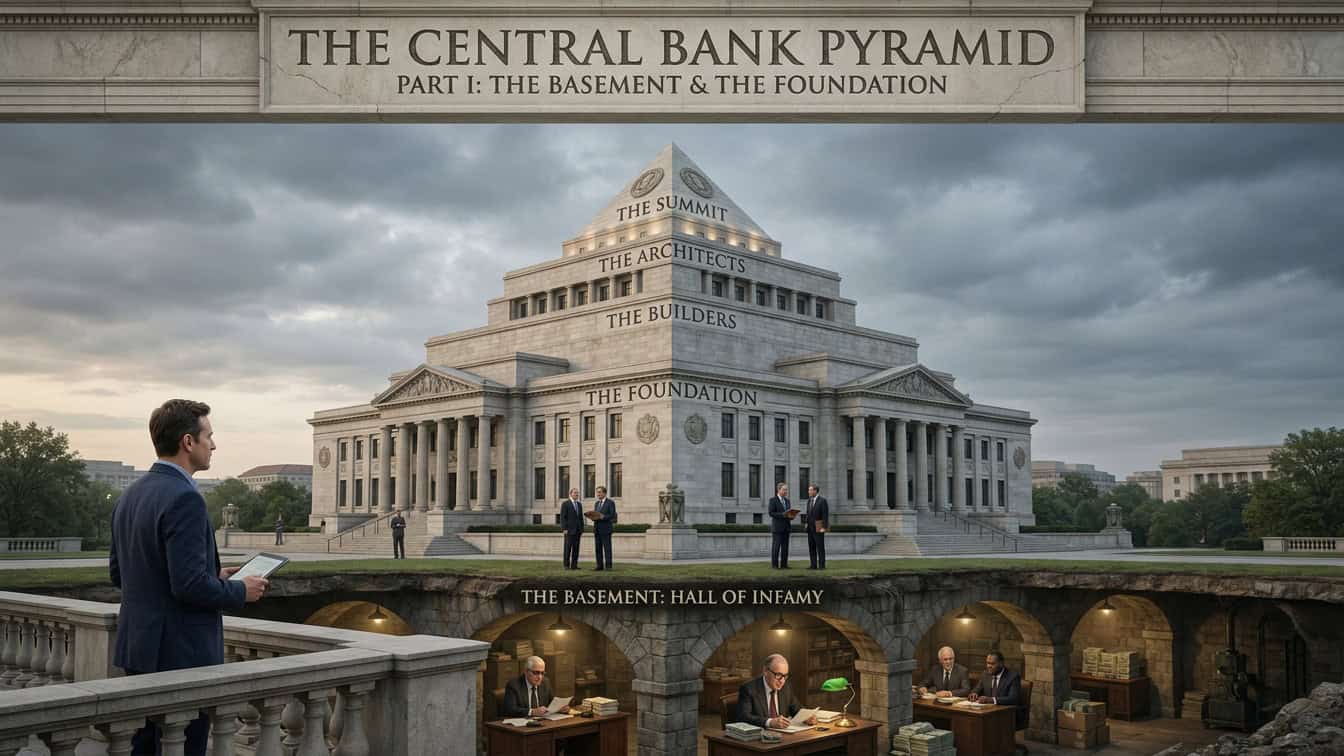
At the bottom of the pyramid is the Basement. That’s where the Hall of Infamy lives, which is reserved for the worst central bankers in history. There are four tiers above the Basement, from the Foundation up to the Summit, which has room for only one name.
This week I’m covering the Basement and the Foundation. Everything above that stays greyed out until I write the sequel to this piece. Here’s an illustration to give you an idea:

The Basement: the Hall of Infamy
Every central banker in the Basement has one thing in common. At some point, they stopped protecting the currency and the economy, and instead started serving whoever had political power.
Even the basement has levels. Let’s go bad to worst.
Rudolf Havenstein and Gideon Gono. These guys are textbook basement cases, from Weimar Republic Germany to more modern day Zimbabwe. Havenstein ran Germany’s Reichsbank as it printed endless money to cover the government’s bills after World War I. Unfortunately prices started doubling every few days by 1923. Some eight decades later, Gono did the same thing at the Reserve Bank of Zimbabwe. He had that Zimbabwe printer humming, funding the state directly until his country was printing hundred-trillion-dollar notes. Same problem each time, even though they were decades and worlds apart — the government spent without discipline, the central bank paid without discipline, and the currency absorbed the cost.
Hjalmar Schacht. We’re back in Germany. Schacht does get some credit though, even in the bowels of the Basement, because he helped end Weimar Germany’s hyperinflation in 1923. Had his career ended there, he may have earned himself a spot on the pyramid, at least at the Foundation level. But Schacht was back at the Reichsbank in the 1930s under very different circumstances, and he built this financing scheme called “Mefo bills.” A shell company issued IOUs to arms makers, and the Reichsbank stood behind them, basically funding Germany’s rearmament without the costs showing up in the budget. He was acquitted at the Nuremberg trials, but he still belongs in the basement because despite brilliant financial engineering, he was hiding Hitler’s war machine. That’s maybe the clearest case of corroding an institution. Do you see what I mean about character and consequences needing to be a thing again?
Alan Greenspan. We’ve finally made it to America. Two Americans live in the Central Bank Pyramid Basement. And Greenspan is probably the most controversial, or at least, debatable. To be clear, I’m not blaming him for failing to predict/prevent the 2007/08 financial crisis. So many intelligent people missed it and made horrific mistakes that allowed it to happen. But Greenspan had the tools to help prevent that crisis and he repeatedly chose not to use them. For example, in 1998, he helped stop the CFTC’s push to regulate derivatives. There was also a 1994 law that gave the Fed power to police abusive mortgage lending, but Greenspan used that power narrowly (with rules designed NOT to slow the growth of subprime lending). Greenspan left the Fed chair in 2006, just before the crash, but he built the system that crashed. In 2008, he told Congress he’d found a flaw in his own model. That flaw cost America (and the world) the worst recession since the Great Depression.
Which brings us to the very bottom of the basement.
Arthur Burns. I’ve written about Burns before when discussing the importance of central bank independence. Burns is the poster child of lacking independence from power, having run the Fed through the 1970s in America during the Nixon years. The Nixon tapes revealed the president leaning on Burns to keep money easy ahead of the 1972 election, and Burns was like a lap dog looking for treats. That lap dog’s decisions helped lead to double-digit inflation and it took a brutal recession to fix it. The funniest part? Burns later gave a lecture on why central banks struggle to resist political pressure. He failed to mention that he was the prime case study.
Someone had to clean up after Burns, and you’ll meet him in my sequel piece.
The Foundation
Welcome to the ground floor of the Central Bank Pyramid. We’re above the Basement. Inside the rooms at the Foundation are central bankers who built something that lasted. Even if they only changed one corner of the system. You may not recognize some of these names, but that’s kind of why they’re here. Each central banker built something you’ve lived in, maybe without even knowing it.
Masaru Hayami. In 2000, Hayami was running the Bank of Japan (BOJ) and raised rates off zero over the government’s objections. Japan slid back toward deflation. I loved his response in March 2001 and it’s a big reason why he’s here: Hayami explained he wasn’t targeting an interest rate, but the amount of money the BOJ pumped into the banking system. It was the world’s first example of quantitative easing. It has been copied by many central bankers since, from Bernanke to the ECB and Japan’s Kuroda. When Japan’s current central bank chair, Ueda, announces the rate call on December 18th, he’ll be writing the last chapter of a story Hayami started (we’ve talked a lot about Japan’s current paradigm shift).
Zhou Xiaochuan. Zhou ran China’s central bank for fifteen years, and was part of China’s economic success story at the turn of the 21st century. In 2005, he moved China’s currency, the renminbi, off its hard peg to the dollar. Then he spent the next decade lobbying for it to be taken seriously amongst the world’s currencies. By 2016, the IMF added the renminbi to its reserve currency basket alongside the dollar, euro, yen, and pound. Maybe a small step in practice, and the renminbi’s share of global reserves is still modest, but it was the first formal move by China to move up the Bond Hierarchy (i.e., getting the world to hold its currency as reserve). Every dedollarization argument and whether the yuan (also the name for the renminbi) can challenge the dollar begins with what Zhou achieved.
Bulgaria’s currency board. In 1997, Bulgaria suffered from hyperinflation and its currency, the lev, was collapsing. It made a radical fix with a new currency board, which tied every lev in circulation to foreign reserves at a fixed rate. First it was tied to the Deutsche Mark and later to the Euro. The Bulgarian central bank gave up its ability to print money at will, and guess what? Inflation stopped! Bulgaria’s currency board held power for almost three decades — through the 2008 financial crisis and the Euro crisis — until Bulgaria joined the Euro this year, as I documented on a recent trip to Bulgaria earlier this year. Few emergency measures have that level of staying power, and we need to celebrate institutional successes like it when they happen.
Joseph Yam. Hong Kong has pegged its dollar to the U.S. dollar since 1983. Yam built the institution, the Hong Kong Monetary Authority, that defends that peg. In 1998, Yam defended it under fire as FX speculators attacked the Hong Kong dollar and the Hong Kong stock market simultaneously during the Asian financial crisis. The peg to the U.S. dollar is now more than 40 years old. It’s older than many of the hedge funds that have failed it break it.
That’s the foundation of the Central Bank Pyramid. Soon we’ll climb the stairs.
Next up: the Builders, the Architects, and the Summit
Many of you can probably guess who I put at the top. He’s a hero of mine. But I doubt you can guess who I put second.
Until then, tell me what I got wrong. Is there someone I left off who belongs with the worst of the worst in the Hall of Infamy? Or perhaps I put someone (like Greenspan?) in the Basement who deserves more consideration? Who’s missing from the Foundation? Let me know in the comments, and the best cases will make it into Part II.


0 Comments